Wild West Landscapes October 2012
[**Just a reminder, landscapes look pathetically puny at 470 pixels wide, but by clicking on an image you can view it at a bit larger scale in a new window.]
Yellowstone is known for its wildlife, but it is also a fantastic place for landscape photography. Especially good because you can include the wildlife in your scenics for added interest and scale. Here are a few of my favorites from our recent mid October trip.
 Ryan brought along a 9-stop neutral density (ND) filter, a high-quality screw in filter from B+W that allows long exposures even on sunny days. I threw it on my Sigma 10-20mm lens to create this 20 second exposure. When on the lens, it is impossible to autofocus, so you need to focus BEFORE putting on the filter. I love the smooth buttery flow of the water and the glow of the shaded rock wall. 10mm lens at f22 for 20 seconds (!) ISO 200.
 We were following a bull elk across the landscape when we topped a rise and found this dramatic scene. I excitedly set up the tripod and then realized I’d left my 70-200mm lens in the car. So off I ran, hopping dozens of downed trees from the fires of 1988 still laying on the ground. When I returned the scene had changed…and not for the better. Still, I like this shot…It has a prehistoric Ice Age feel. Canon 70-200mm f4 lens at 200mm.
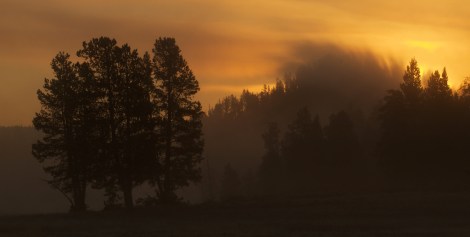 We thought this cloudless morning would mean a drama-less dawn, but steam from the Firehole Geyser basin created this sunrise scene. Canon 70-200mm lens handheld braced on car door.
 The shaded canyon of the Firehole River at dawn. The water, heated by geothermal features upriver, steams on cold mornings. The pre-dawn blue was emphasized in Aperture. Canon 70-200mm lens handheld.
 Our trip coincided with clear night skies and a very late moonrise which enabled us to get great shots of the Milky Way. This one was taken straight up through the Ponderosa Pines, which were lit by just the glow of a campfire. Sigma 10-20mm lens at 10mm f4 for 30 seconds. ISO 800. On a tripod. Tungsten white balance.
 Is this a landscape image OR a wildlife shot? Not sure really, but I like the peaceful feel of the grazing Bison along the Firehole River (Fountain Flat Drive). Canon 70-200mm lens at 122mm. f7.1 at 1/400 second on tripod.
 These “skeleton trees” near the Firehole Lake Drive never seem to disappoint. We have shot here many times and the conditions always seem to be different. Blue cast emphasized in Aperture. Sigma 10-20mm lens at 14mm, f9 1/1000 second. Tungsten white balance.
 October 28, 2012
 Sparky Stensaas
 5 Comments


 thesparkygroup@gmail.com