Archive for September, 2012

Moose! Called in to 30 yards: Shooting with Sparky

My hand was actually shaking…I eyed my “escape route” one last time, wondering how fast I could really climb that birch…Because I could hear large branches breaking and the deep guttural grunt of a bull Moose getting closer. I calmed myself and found the very tall dark blob through the vegetation in the viewfinder, focusing until the blob became the sharp image of a bull Moose. He was staring straight into my eyes…or the singular “eye” of my lens… I couldn’t tell which. His nostrils flared, trying to catch the scent of a cow Moose, and drool dripped from his mouth. Now was the critical time when he had to decide if he should come closer or retreat. He circled around me to get a better look…Maybe to actually get a better smell, since their eyesight is not great. As he shook his back and head violently, morning dew flying off his hump, his ears making audible flapping sounds, one could get a glimpse of the strength and power these animals possess. After another stare down, he moved off towards the west, grunting a few times as he departed. Sorry buddy…Hope you get lucky next time.

I’ve called in Moose before (see this post about a 2-Moose Adventure), but each time it is a rush…a thrill. Of course there are many unsuccessful attempts that make the successes so much sweeter. It was just a good day to be in the woods and there were many more highlights to come…a male Spruce Grouse feeding on the road, a Timber Wolf that appeared about 40 yards from me but then disappeared silently before I could get a shot, a Goshawk streaking through the trees. Then the most bizarre encounter…I drove a remote 2-track road a couple miles to a little used trail head…I’d only seen a couple grouse hunters all day…but there was a car here…odd, I thought…then my friend and fellow wildlife photographer Jason comes out of the woods on the trail. Crazy! We talked wildlife encounters for about an hour before my day-ending hike into the Boundary Waters Bog Lake. Yeah, a good day.

Iowa Prairie Monarchs…from 4 inches away!


I really have a passion for “wide angle wildlife”…which can be a challenge with critters…most of which would rather be a long ways away from us stinky, scary humans. And, of course, to get the bird, mammal, reptile or butterfly a respectable size in the frame, and not just an indistinguishable dot, you have to GET CLOSE!

So, on September 6th I found myself taking a detour off the highway near Lime Springs, Iowa to check out Hayden Prairie State Reserve. It is a 242 acre parcel of tallgrass prairie..and sadly the largest tract in the state outside of the Loess Hills. The prairie honors Ada Hayden, an Iowa farm girl who became one of the first woman botany professors in the country, receiving her PhD in 1918.

I had a few hours to shoot before sunset and I noticed many Monarchs feeding on the sunflowers and goldenrods. But getting close to the Monarchs was not easy…First I tried just walking up to nectaring Monarchs on the head-height sunflowers…but they didn’t appreciate that. Then I discovered a patch of goldenrods where the nectar must be especially good and abundant. The butterflies were a bit more tolerant here. And as anyone who’s shot a lot of wildlife knows, every individual has a different comfort zone. So I just kept trying to find a mellow Monarch.

The image I had in my head was getting the Monarch large in the frame, shooting into the sun so the sky was dark and the sun would be a starburst. Backlit subjects can make for tricky exposures. I knew I had to shoot at high-speed sync in order for the butterfly and sky to be in the same exposure range. I’d pre-set my camera on manual exposure to f22 at 1/1250 and my Canon flash was set to high-speed sync. Then I autofocused on my hand at 4 to 6 inches and then turned off the lens autofocus. The technique was to crawl as close as I could to the Monarch, then extend my arm with the camera and start shooting…keeping my finger on the shutter button as I reached out towards the butterfly. It was low percentage shooting but lots of fun. My knees paid the price though.

The photos here are images you could not get with a telephoto lens…Note the extreme depth of field in the shots.


Crawling through tallgrass prairie can be tough on the knees…and jeans!
The Monarchs were starting their migration south to Mexico’s Mariposa Monarca Biosphere Reserve where they would overwinter. As any school kid knows, this migration is one of the most amazing in the animal kingdom…A fragile butterfly flying several thousand miles south to the mountains of Central Mexico where this species has likely overwintered for thousands of years. Even more amazing may be the fact that it is a different generation of Monarchs that returns to the north each spring. You can actually track the Monarch’s southward flight on the internet. Check out Journey North’s Monarch Migration map here to check on their southward flight.
To get the “starburst” sun you need to be shooting at f16 or smaller aperture.

Baptisia leucantha Largeleaf Wild Indigo or White Wild Indigo, a unique tallgrass prairie plant. Note the crazy large seed pods.

[All photos taken with Canon 7D and Sigma 10-20mm lens (between 10mm and 16mm) at f22, ISO 400, 1/1250 second, Canon 420ex flash set to high-speed sync at -2EV]

Spruce Grouse video (check out those sexy red “eyebrows”!)

Birders and photographers from across North America put the Spruce Grouse high on their list of highly desirable target birds. Many of the folks I guide in winter would love to add this grouse to their life list. We usually cruise Superior National Forest roads at dawn hoping to catch a glimpse of one picking grit along the shoulder. And we pray that no logging trucks have already spooked (or smashed) the birds before we get there. Like many boreal birds, it is not rare, but rather rarely seen, due to the inaccessibility of their remote boreal forests and bogs in Canada, Alaska, Maine and Minnesota. Lake County has a reputation for being THE spot to find them (They do not occur in the Sax-Zim Bog).

I found this male Spruce Grouse picking grit along a remote dirt logging road in northern Minnesota’s Superior National Forest a few days ago (early September 2012). He was a long ways down the road but I thought I’d get some “insurance shots” anyway. So I eased out of the car, put the camera on the tripod (set to its lowest level) and threw some camouflage netting over me and the camera and started stalking. I’d shoot some video and some stills and then move about 15 steps closer…slooowly. Then I’d sit for a while until he began feeding again. Initially I had stacked a 2x and a 1.4x telextender on the 400mm to get enough reach, and had to shoot at ISO 3200 (noisy!), but eventually, after getting much closer, I was able take off the 2x telextender and reduce the ISO to 800.

You can turn the HD feature on or off depending on the speed of your computer.

He flew up into some Tamaracks and began feeding on the needles. In summer they eat insects, blueberries, leaves, fungi and other berries. In fall and winter they switch to a diet of conifer needles. Tamaracks are utilized in fall before they lose their needles in mid to late October. Black Spruce and Jack Pine needles are the preferred winter food. They can store up to 10% of their body weight in needles in their crop. The slow digestion of this food during the long northern nights helps keep them warm. The grit picked from the road helps the gizzard break down the needles. I once found a road-kill Spruce Grouse and dissected it. I found that that individual only picked white/clear quartz stones for its grit….Maybe it instinctively knew that the quartz is very hard with sharp corners and would be a great needle grinder. Oh, and by the way, I ate that road-kill Spruce Grouse after dissecting it! I had to prove/disprove the myth that “spruce hens” taste like pine needles. In fact, it was as tasty as any Ruffed Grouse I’d ever eaten. Myth busted!

Shot with Canon 7D and Canon 400mm f5.6 and 1.4x telextender on tripod. Camo netting over me and camera for stealthy approach.

Hummingbird Hijinx: How to get awesome hummer/native plant images

Female Ruby-throated Hummingbird at Turk’s-cap Lily, Skogstjarna, Carlton County, Minnesota (i.e. my “backyard”)

The whole family has had a blast watching the Ruby-throated Hummingbird antics at our backyard feeder this summer. We’ve had up to 4 around the feeder at once. Though there are six feeding holes in the dispenser, they seem unable to feed peaceably next to each other. Fights are non-stop. For a while we had the “bully,” a male who sat like a king on his throne on the hanging bracket and chased away any nearby hummer…even when he wasn’t interested in feeding. The last few summers we’ve had the feeder out by the garden, but moving it to the “backyard” was the best move we could have made. Our large picture windows allowed great viewing and also helped remind us when the sugar-water mix was low or out. We used to forget about it when it was by the garden and let it run dry much to the hummers chagrin.

Here is an example of a flash image that I don’t like as much as the non-flash image below. (Liatris bloom)
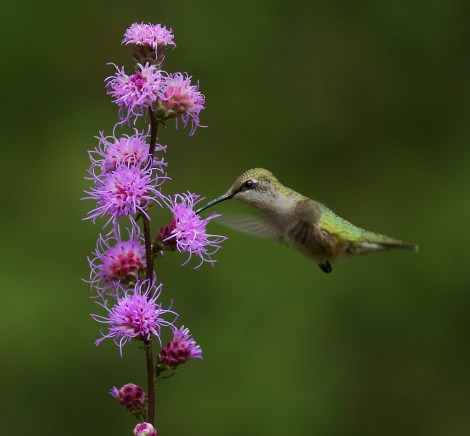
And this is why you keep your finger on the shutter even after your flash fires. Sometimes you like the non-flash image! Though only shot at a relatively slow 1/250 of a second, the hummer’s head is sharp, which proves that though hovering with wings beating at 55-70 times per second, their head is absolutely still. Amazing! This might be my favorite from “the summer of the hummer.”

My first goal was to get some photos of Ruby-throats feeding on native flowers…A very difficult shot in the wild. Why is this type of image tough to capture? Because in the wild, you can’t control the situation. If you plant yourself near some highly desirable hummingbird flowers (Liatris, Monarda, Milkweed, etc) you never know when one might show up, and then it will be cautious of that weird large human with the “bazooka” pointing at it. On the other hand, if you stumble upon a feeding hummer, it is highly unlikely that you’ll have time to focus, position the flash, get the correct exposure and fire off a shot before the hummer moves on, as they normally quickly move from flower to flower.

plampThe native plant/clamp hummingbird set up.
A female comes in to an irresistable Morning-Glory bloom.
Here’s where the hummer’s long bill and tongue really come in handy; deep corolla flowers like Morning-Glory “hide” their nectar deep inside.

NOW, HOW TO DO IT (FOR ALL YOU FELLOW PHOTO NERDS!)
To get clean hummingbird images, you need to control the situation. First I gathered a native and photogenic flower and put it in water so it wouldn’t wilt. I then set up my camera on a tripod about 25 feet from the feeder. You have to judge the distance for yourself and what lens you are using, but you want enough room surrounding the flower to allow for the body of the hummer. You don’t want to be so tight that you clip part of the bird. Err on the side of too much space around the flower as you can always crop later. I attached my flash and to that attached a Better Beamer (a flash attachment that uses a fresnel lens to concentrate the beam of your flash so it projects further).

Now, I took the native flower and attached it to the bracket that the feeder was hanging on. I used a regular clamp this time but often use the “plamp” (plant clamp) from Wimberley to do this. One end has a beefy clamp that can attach to tree branches, a tripod leg, or in this case, the hanging bracket. You can then twist and bend the plamp into any position you need. The flower end of the plamp has a swiveling low tension clamp so you can fine tune the flower’s position.

Quickly test your set up. Position your tripod so that you will be shooting exactly perpendicular to the feeding hummingbird (if this is the shot you want). This is possible with Morning-Glory but not with Liatris where they can feed on all sides of the flower. Also look for the best background for your images. You don’t want distracting branches, blown out sky, ugly browns in your background. This is a VERY important step that can make or break a photo. Since I am in a very wooded spot, I am especially worried about “hot” branches, branches lit up by the sun that cause very distracting light lines,blobs in the final photo. What I do look for are nicely lit, even green foliage that I know will blur into a smooth green background.

I pre-focus on the spot where I want the hummingbird and then turn off the auto focus on the lens. This way I don’t have to be looking through the camera when I’m shooting. I just watch and press the shutter when I think the hummer is in position. Now quickly fire off a few test shots. Exposure is always a compromise between shutter speed and aperture. You want a relatively shallow depth-of-field (DOF) to get out-of-focus backgrounds BUT you also want enough DOF so both hummer and flower are in focus. A delicate balancing act for sure. Most are shot at f5.6 to f6.3. For the majority of these images I used high-speed sync for my flash, shooting at 1/1000 of a second (all but the Liatris images). But I don’t think I’d do this again. I like some blur in my hummingbird wings…It adds some drama, reality, motion into the image…And even 1/1000 doesn’t come close to freezing them…And high-speed sync seems to take more effort from your flash so it doesn’t recycle as quickly as when shooting at its regular 1/250 sync speed.

The final key to this operation is to cover the hummingbird feeder completely with a towel. You can also remove the feeder if you like but I found this just an extra unnecessary step. Now plant yourself next to your camera and get ready…finger on the shutter button. Because if you have an active feeding station it won’t take long for the first hummer to come zinging in. He/she will seem confused at first, trying to get at the covered feeder, but then it will see the showy flower you provided conveniently at hummer-head height, and think to itself, “Why not? It’s here, it has nectar, might as well try it” and that is when you start firing off shots as fast as your flash will recycle. But actually I just keep shooting because even non-flash images in a sequence can be beautiful.

This set-up really works well on established hummingbird feeders…but only for a few minutes…until all the local hummers have been fooled and tried your flower and used up the nectar. So I immediately take down the flower and uncover the feeder after my photo session…Usually less than half an hour. You don’t want to frustrate your guests too much so they go over to your neighbor’s feeder!

My big failure for the summer was NEVER getting a male to feed on “my flower”…I think all the images here would be enhanced with the male’s iridescent throat feathers shining like a ruby in the sunlight/flash burst. Oh well, there’s always next summer!

**[All images take with Canon 7D with Canon 400mm f5.6 lens and 430EX flash with Better Beamer attached. Tripod. Most at f5.6 or 6.3 at ISO 200 to 400, 1/250 to 1/1000]

Free Wildlife & Nature photos to small non-profits & schools

Please pass this link around if you know someone who is involved with a small non-profit or school that could use any of my wildlife or nature photos for their EDUCATIONAL projects.
As the new Executive Director of Friends of Sax-Zim Bog (a 501c3 non-profit http://www.SaxZim.org) I know how tight budgets can be. Don’t get me wrong, I am a fierce advocate of photographers getting paid for their work—Would you ask a plumber to give you free service just because he/she LOVES his/her job? The answer is NO, but yet photographers are asked all the time to give their photos away…often by organizations or companies that pay their CEO 10-times my annual take-home. But education about the natural world is one of the BIG reasons I love wildlife/nature photography, and I am happy to give it away to small non-profits and schools who are trying to do the same. Forward this to any teacher or non-profit employee or board member that you think might be able to use my images. Thanks!

There are a few stipulations:
1. The non-profit must have an annual operating budget UNDER $250,000
2. Photos may ONLY be used for EDUCATIONAL projects and materials (kiosks, brochures, flyers, classes, programs)
3. Photos MAY NOT be used for creation of products that will be sold to raise money; e.g. calendars, mugs, t-shirts (*Unless I give permission before hand).
4. All images used must be accompanied by a photo credit which reads “Sparky Stensaas/www.ThePhotoNaturalist.com”
5. Please contact me at thesparkygroup@gmail.com or at 218.341.3350 to get permission, choose file size, and discuss the image’s use.

Go to www.SparkyPhotos.com to peruse the galleries and choose images.

ORGANIZATIONS WHO HAVE TAKEN ADVANTAGE OF THIS OFFER
A. Hawk Ridge Bird Observatory
B. Friends of Sax-Zim Bog
C. Hartley Nature Center
etc.
Texas Horned Lizard (Phrynosoma cornutum—Sick Dog Ranch near Alice, Texas)
Coyote pair hunting (Yellowstone National Park, Wyoming)
California Poppies (Lancaster, California)
Birk Anders Stensaas at Hawk Ridge (2 years old)
Paddling the Boundary Waters Canoe Area (Gunflint Trail, Minnesota)