“You sold a photo of an immature Ring-billed Gull?!”

Ring-billed Gull Duluth MN tungsten w-2 1-2 CTO gels on flash IMG_0065785

I NEVER EVER, for one second believed that I would ever sell an image of a Ring-billed Gull…Let alone an immature bird! Most folks in Duluth refer to them as “flying rats.” They are ubiquitous in Canal Park by the Aerial Lift Bridge, living on popcorn handouts from tourists, garbage and god-knows what else. But that is where the miracle mix of keywording and Google search make their magic. Evidently, a creative director in England did a search for something about “flash” or “gel” and wildlife photography, and this image popped up. (See the original blog “Gulls in my Face: How to Make Gulls look Sexy” post Here)

This was just a great reminder that we should always keyword the images we put online (if you have any interest in making photo sales). And not just our favorite images…even ones of immature “flying rats!” Also remember that if we update our websites/blogs frequently, our images will also pop up higher in all search engines.

Here are the keywords I tagged this image with before I posted it in a blog post: “aerial lift bridge, bird, Duluth, flash, flying rats, gel, gel-covered flash, gull, Ring-billed Gull, tungsten”
Now that I see the actual keywords, I think I’d add the following: “creative, wildlife photography, bird photography, orange gel, CTO, sky rat, flying, flight”

Digital Camera gull orange gel spread page SMALL

Digital Camera magazine cover Sparky gull orange gel image SMALL

My photo/article appeared last month in Digital Camera, a slick British magazine (also sold at Barnes & Noble).

Here is the text I submitted:
“I love a couple of things that most people dislike…gulls (no such thing as a “seagull”) and dark overcast skies for photography. To combine these two to create an artistic, out-of-the ordinary image, I decided to create a “cold-warm” look by setting my camera’s white balance to “tungsten,” (which makes the dark gray sky a pleasing blue) and using two 1/2 CTO (orange) gels on my flash to cast a warm light on the nearby gulls (if you just used straight-up flash, the gulls would also look bluish). I used auto TTL flash but adjusted the power up with the flash exposure compensation dial. Also make sure you underexpose the scene to add drama to the clouds.

One challenge is finding wildlife subjects that allow close approach. You need to get close so the flash can illuminate your subject. Gulls are human groupies and any old chunk of stale bread will bring them in and make them your friend forever. Gray sky days are also required, but these never seem to be in short supply!”

Caption Ideas?

Taken on a cold spring canoe trip on the Mississippi River (northern Minnesota) years ago. Have to thaw your honey somehow!
North Woods hot tub 167_6707

Tamarack-ulous!

It is the time of year when almost all the deciduous trees are past peak and many have lost all their leaves. But there is one amazing tree that is just coming into its full glory…The Tamarack. This is our only deciduous coniferous tree. What? It means that though it has needles like spruces, fir, pine, they all drop off the tree every fall (deciduous)…But before they do, they turn an amazing yellow-gold, making the bogs blaze with color.

Tamarack Reflections Lima Mtn Road Cook Co MN SparkyStensaas 778_7861 (1)Sadly, this scene will never be repeated…These perfectly situated Tamaracks along the Lima Mountain Road in Minnesota’s Superior National Forest have all succumbed to the Eastern Larch Beetle.

FUN TAMARACK FACTS
1. The name “tamarack” comes from the Algonquin people of eastern Canada and means “wood used for snowshoes.” The Algonquins also gave us the name “moose.”
2. Also known as “larch” and “hackmatack”
3. Grows from Labrador to the Yukon and Alaska, south to Minnesota, Wisconsin, Michigan east to Indiana, New York, Maryland. But the largest pure stands in the Lower 48 are in Minnesota.
4. Latin name is Larix laricina
5. Extremely cold tolerant! Can survive winter temps down to MINUS 85 F!
6. Also very rot resistant…In fact, when we built our house, our builder suggested Tamarack for the front porch. We had a local mill saw it up for us.
7. Eastern Larch Beetle (Dendroctonus simplex) is a native enemy of the Tamarack. Outbreaks in the Sax-Zim Bog of northern Minnesota have been quite severe in recent years. A bane to the trees, is a boon to woodpeckers, bringing in irruptions of Am. Three-toed Woodpeckers and Black-backed Woodpeckers who flake bark from the trunks to get to the juicy grubs beneath. These rarely seen birds also bring in throngs of birders to see the birds.

Northern Hawk Owl NHOW-SS (Friesens Test)Ryan Marshik and I found this Northern Hawk Owl on a early November foray to Minnesota’s Sax-Zim Bog. It was perfectly teed up on a Black Spruce with a background of slightly-past-prime Tamaracks. Ryan quickly and graciously loaned me his Canon 500mm f4 and 1.4 extender and we were able to get this shot out the window of the car.
[Canon 10D, Canon 500mm f4 lens w/1.4x tele-extender, f5.6 at 1/160 second at ISO 400 (taken in 2004)]

Tamarack Yellow Motion Blur Toivola Swamp Sax-Zim Bog MNA very windy day in the Toivola Swamp adjacent to the Sax-Zim Bog. I decided to interpret the Tamarack gold in a new way…Leave the shutter open for a longer exposure and let the wind do its thing. And the amazing thing is that I like the result!
[Taken in the “film days”…Can you believe it?! …Probably with a Nikon FM2]

Gray Jay in gold Tamarack Admiral Rd Sax-Zim Bog MN IMG_8946Taken just a few days ago in the Sax-Zim Bog as the Tamaracks were approaching peak color. This curious Gray Jay came in to my squeaks. I like the fact that the Jay shares the starring role with the wispy yellow Tamarack foliage.
[Canon 7D with Canon 400mm f5.6 lens, f5.6 at 1/250, ISO 400, Canon 420EX flash (without Better Beamer)]

Tamaracks McDavitt Rd Sax-Zim Bog MN IMG_9306Tamaracks and a brooding sky, Oct 21, Sax-Zim Bog.
[Canon 7D and Tamron 60mm f2 lens]

Hairy Woodpecker in gold Tamarack Admiral Rd Sax-Zim Bog MN IMG_8934A bit of yellow Tamarack foliage adds nice contrast to the primarily black-and-white Hairy Woodpecker. The red bar on the back of his head makes this Hairy a He and not a She. Sax-Zim Bog, MN.
[Canon 7D with Canon 400mm f5.6 lens]

Best Caption Wins!

Taken at my sparrow feeding station at my home in Carlton County, Minnesota. Who has an idea for a caption? Contribute your caption here or on my facebook page here. Let the puns fly!
Black-capped Chickadee and garden gnome Skogstjarna Carlton Co MN IMG_9110

Attracting Hawks with a Feather Duster

American Kestrel male Hawk Ridge Duluth MN IMG_7609A forecast for strong NW winds in Duluth, blew me right up to Hawk Ridge earlier this week. Northwest winds pushes south bound migrating raptors towards the shoreline of Lake Superior. But the hawks don’t want to fly over the big lake…No thermals to ride, no food, no resting spots. So they funnel down the North Shore of Lake Superior right over Duluth and Hawk Ridge. Strong winds also keep the birds low, which is important for photography.
A photographer from Chicago had put his self-proclaimed “feather duster” owl on a tall pole on one of the overlooks at the Ridge. The thought is that some feathers waving in the wind will add an element of realism to a very rigid decoy. I had brought my plastic owl as well, but “Earl” stayed earthbound this time. The idea is that since hawks HATE Great Horned Owls, they’ll pause, fly over, and maybe dive bomb the faux owl, giving the photographer a fighting chance at capturing an in-flight hawk photo.

American Kestrel male Hawk Ridge Duluth MN IMG_7620

American Kestrel male Hawk Ridge Duluth MN IMG_7611Kestrels have always eluded me… Just try stopping alongside a perched kestrel and see what happens. Off they go, with their back to you. But today, finally, SUCCESS! Tracking these mini-jetlike falcons is extremely difficult, but the 400mm f5.6 locked on this time and I got nice sharp images. Key to this success were my camera settings: I knew I needed a shutter speed of about 1/2000 of a second to freeze the motion of a speeding raptor, and I knew I didn’t care so much about the aperture (even at f5.6 the entire bird would be sharp), and there was plenty of light. These 3 factors led me to set the camera to Tv (Shutter Priority) at 1/2000 of a second and auto ISO.

Sharp-shinned Hawk adult Hawk Ridge Duluth MN IMG_7634Sharp-shinned Hawks really find owls irresistible, and several made attacking passes at the owl. My goal is to get images showing the uppersides of the hawks, ideally with either a blue-sky background or a back drop of fall colors. Shots from underneath are a dime-a-dozen…Great for identification but pretty boring shots. Note that the dark bluish back and tail, and deep red eye, signify that this is an adult bird.

Sharp-shinned Hawk adult Hawk Ridge Duluth MN IMG_7660I love being able to shoot down on the hawks as well. The turning fall colors makes a nice backdrop for this migrating Sharp-shinned Hawk.

Golden Eagle juvenile Hawk Ridge Duluth MN IMG_7581My first Golden Eagle of the year! A few hundred migrate from eastern Canada south over the Ridge each fall. You can tell this is a juvenile by the pattern of white underneath…dark underwing coverts and white at the base of the primaries and secondaries. Adult Goldens would be all dark under and juvenile Bald Eagles would show some white on the underwing coverts.

Sailboat Lake Superior Duluth IMG_7698Recent heavy rains caused red clay sediment from the St. Louis or Nemadji Rivers to wash out into Lake Superior.

Sharp-shinned Hawk adult Hawk Ridge Duluth MN IMG_7638A white-cloud background gives this Sharp-shinned Hawk portrait a unique look. I purposely let the whites blow out so that the hawk looks as if it was clipped from its real background.

Owl decoy feather duster IMG_7590Here is the “feather duster” owl decoy. He earned his pay today! And nary lost a feather.

Broad-winged Hawk Hawk Ridge Duluth MN IMG_7516The last few stragglers. Broad-winged Hawks are specialists on frogs, snakes and insects…so October 7th is pretty late for them. This is one of 3 that soared over early in the day. Note the banded tail of this adult.

Sandhill Cranes Hawk Ridge Duluth MN IMG_7556You often hear Sandhill Cranes before you see them…and that was the case here. A small flock of 4 soared effortlessly over the Ridge…Probably on their way to wintering grounds in Texas.

Red-bellied Woodpecker Hawk Ridge Duluth MN IMG_7669A rare visitor! Red-bellied Woodpeckers breed mainly south of Duluth, but this one made a brief appearance at Summit Ledges. We first heard it calling.

We also had a Merlin and Northern Goshawk (juvenile) dive on the owl, but I missed all those shots. This is a low-percentage endeavor! Turkey Vulture, Red-tailed Hawk and Bald Eagle also flew by. Meadowhawk dragonflies were also very common.

[All images shot with Canon 7D and Canon 400mm f5.6 lens: Most at Tv (Shutter priority) 1/2000 second and Auto ISO (resulting in shooting at f5.6 for most]

Place it, and they will come. Belted Kingfisher

Belted KingfisherWith apologies to Kevin Costner and the creators of the movie, Field of Dreams, I have modified the phrase “Build it and they will come.” to “Place it and they will come” and by “it” I’m referring to a convenient perch for a bird.
In this case, I had often seen and heard Belted Kingfishers at a nearby marsh. But they were usually perched far out in the water (Where there were perches!). Not great for photos. Plus, Kingfishers are one of the most spooky of all birds…Meaning they fly at the first sight of a human. So I found a spot on the edge of the marsh where I could get a clear view of the water. I found a good looking perch in my woods at home, hauled it to the spot and stuck it in the mud. I set up my pop-up blind about 20 yards away and waited….But I didn’t have to wait very long as a Belted Kingfisher found the perch within 15 minutes!


SHOOTING WITH SPARKY: PLACE IT AND THEY WILL COME. Join Sparky in the field as he shoots Belted Kingfishers.
Note the series of photos where the Kingfisher misses the perch and makes an amazing recovery!

Belted Kingfisher Kimmes-Tobin Wetlands Douglas Co WI IMG_5801I froze the second she landed ….I did not want to spook her…so I waited until she was relaxed and fishing. Then I started shooting. My leg fell asleep and my neck got stiff from trying to remain motionless in the blind.

Belted Kingfisher Kimmes-Tobin Wetlands Douglas Co WI IMG_5809

Belted Kingfisher Kimmes-Tobin Wetlands Douglas Co WI IMG_5828I knew it was a female because of her orange breast band…Females are actually more colorful than the males…Rare in the bird world!

Belted Kingfisher Kimmes-Tobin Wetlands Douglas Co WI IMG_5851

Belted Kingfisher Kimmes-Tobin Wetlands Douglas Co WI IMG_5852
[All shot with Canon 7D and Canon 400mm f5.6. Aperture-priority f5.6 and ISO 320 so shutter speed would be 1/1600 or 1/2000 and I could freeze any action]
[Wide angle video shot with Canon 7D and Sigma 10-20mm lens]

Ten Reasons NOT to take Fall Color Photos

Here in Northern Minnesota, this weekend is looking nasty…rain, strong winds, cold. But the leaves are starting to really turn. I thought it might be time to bring back this post from last fall.

1. I CAN’T FIND A GOOD COMPOSITION
SOLUTION: Make your own! I found this dewy Quaking Aspen leaf and very carefully placed it on a background of reversed maple leaves that I laid out. I love the contrast of the yellow with the magenta.

2. IT’S CLOUDY OUT
SOLUTION: No problem, cloudy and foggy days are the best for recording the saturated colors of fall. Even rainy days can be great. But remember to use a polarizer to reduce the sheen from wet leaves.

3. THE LEAVES HAVE ALREADY FALLEN
SOLUTION: So what?…The leaves can be just as pretty and colorful on the ground.

4. I WORK DURING THE DAY
SOLUTION: Get out early! Frost on fall leaves can be a dramatic element

5. TOO LATE…SNOW HAS ALREADY FALLEN
SOLUTION: Count your lucky stars because this is a rare event. Get out right away and find some colorful leaves dusted with snow to make a stunning shot.

6. IT’S JUST A JUMBLE OF LEAVES, TREES, AND COLOR OUT THERE…I CAN’T FIND A SUBJECT
SOLUTION: Isolate! Find a clump of particularly beautiful leaves…or an individual fallen leaf…or grab the telephoto lens to highlight one area of color.

7. THE LEAVES WON’T STAY STILL
SOLUTION: Use this to your advantage…If leaves are swirling in an eddy of a river or creek, just set your tripod up and shoot at a very slow shutter speed…Slower the better. The leaves will become a swirl of color but the rocks and shoreline will be sharp.

8. I CAN’T FIND ANY COLORFUL LEAVES
SOLUTION: Shoot brown leaves

9. I ONLY BROUGHT MY WIDE ANGLE LENS
SOLUTION: The best lens is the one you have with you…So use it! But you have to be careful with wide angle fall foliage shots that you don’t include too much of a gray sky. Here I intentionally eliminated the sky to focus on the variety of colors in a wooded meadow.

10. I ONLY BROUGHT MY TELEPHOTO LENS
SOLUTION: Perfect…Much easier to find good compositions with a medium telephoto (70-200mm) than with a wide angle lens, I believe. Head to a vantage point or lookout where you can isolate part of the scene like in this image from Oberg Mountain, Minnesota, Lake Superior North Shore.

There you have it…A bunch of reasons NOT to shoot this fall’s gorgeous leaves…And a bunch of solutions to these common excuses. Now let’s get out there and shoot like crazy before all the leaves are gone!

From Namekagon through Crex Meadows

I had a speaking gig in southern Minnesota a couple weeks ago (Sept. 17 to be exact…I’m a bit behind on my editing!) but I didn’t feel like just driving the interstate (I-35) down to Austin…Much too boring. Why not get some photography in? So I drove south on Wisconsin 35…a 2-lane highway that gets me close to one of my all-time favorite wildlife photography locations…Crex Meadows.
spruce tree dawn silhouette WI IMG_6117sun breaking through fog WI IMG_6147Fog shrouded the low-lying spots along the highway, then as the sun rose, rays broke through, illuminating the mist, making it glow. I pulled the van over immediately, knowing the sun would burn this fog off quickly. I managed to get these ethereal shots…silhouette of an old spruce (above) and the sun rays in the fog.

Bald Eagle Namakagon River WI IMG_6216Further down the road, I crossed the Namekagon River (part of the St. Croix National Scenic Riverway). I stopped and spent some time here as the scene was changing from hazy foggy misty goodness to pure morning sun. This Bald Eagle magically appeared, hunting down the river corridor. I wish I’d captured the wings in a better position but I like the silhouette anyway.

Red-tailed Hawk Namakagon River WI IMG_6211An old White Pine along the river made a choice perch for this Red-tailed Hawk. I chose a wider view, giving the branch itself a bit of a starring role. I like the composition.

Red-tailed Hawk coughing up pellet Namakagon River WI IMG_6212Wildlife behavior is always interesting to capture, but not easily done. The Red-tail started making odd movements and I knew it was about to cough up a pellet. I fired off a series of shots. You can see the pellet falling to through the air. I wish I had time to take a video of this. Oh, well. (pellets are conglomerates of undigested bone and hair that are regurgitated by birds of prey and many other birds…including hummingbirds! In addition to nectar, they eat insects, some with hard wing cases or larger wings, that need to be coughed up.)

Pied-billed Grebe Crex Meadows Grantsburg WI IMG_6428Pied-billed Grebes were very common at Crex Meadows this day. This pond had 5 hunting in fairly close proximity. I saw this guy struggling with a fish so I grabbed some shots as it flew off with its prize bullhead. It eventually was able to turn it in its bill so it could slide down its throat head first.

Paper Birch Crex Meadows Grantsburg WI IMG_6412The first hints of fall color in a stand of Paper Birch.

Blue-winged Teal flock Crex Meadows Grantsburg WI IMG_6549Blue-winged Teal flock.

Northern Harrier Crex Meadows Grantsburg WI IMG_6547Northern Harriers spend much of their time gliding over marsh land and meadows searching (and listening) for voles, mice, shrews and small birds. Owl-like facial disks focus sounds in the grass on their ear holes thereby aiding in triangulating the location of unseen prey. The females, like this one, are brown; Males are a striking light gray. Both have the white band on the upper tail.

Sandhill Crane Crex Meadows Grantsburg WI IMG_6252 (1)A lone Sandhill Crane forages along the shore. Crex Meadows is known for its huge concentration of fall migrating Sandhill Cranes. It is an important stop over for their migration.

Short-billed Dowitcher juvenile Crex Meadows Grantsburg WI IMG_6386Sometimes you get lucky. Sometimes you find a subject that is comfortable with your presence. You have to take advantage of these rare moments. This Short-billed Dowitcher (juvenile) allowed me to actually get out of the van and sit quietly at the edge of the water while it fed, waded, swam, bathed, and preened only 30 feet away! These are my best Short-billed Dowitcher pictures by far.

Short-billed Dowitcher juvenile Crex Meadows Grantsburg WI IMG_6398

Short-billed Dowitcher juvenile Crex Meadows Grantsburg WI IMG_6341

Short-billed Dowitcher juvenile Crex Meadows Grantsburg WI IMG_6382

Short-billed Dowitcher juvenile Crex Meadows Grantsburg WI IMG_6357

Trumpeter Swan Crex Meadows Grantsburg WI IMG_6534Trumpeter Swans nest in good numbers at Crex Meadows. This adult was one of a pair that had 4 nearly grown cygnets. Cygnets do not get their white plumage until they are a year old. Also note the pink on the juvenile’s bill.

[all wildlife shots with Canon 7D & Canon 400mm f5.6 lens, hand held]

14 Tips for shooting your Vegetable Garden

It’s harvest time! And this is a great time to photographically record the fruits of your labor (veggies of your labor?). So far we’ve been eating peas, beans, cherry tomatoes, broccoli, lettuce, basil, and potatoes from my wife’s 16×30 foot garden. The Roma tomatoes, squash, carrots and beets are not quite ready.

1. NATURE’S BOUNTY
Gather up some of your harvest and arrange in a basket or on your picnic table. Then get close so you fill the frame with produce. This works best in open shade or on high overcast days. Even just picked dirt-covered potatoes can look good like this!

garden vegetables Skogstjarna

Gourds2 Carlton Co MN IMG_0051521
Potatos Bridget's Skogstjarna Carlton Co MN IMG_0014628

Strawberries IMG_0632

Gourds Carlton Co MN IMG_0051527

2. DON’T POO POO CLOUDY OR RAINY DAYS
Light overcast days can be the best time to shoot in your veggie garden. Why? Because the clouds are acting like a giant reflector in the sky and evening out the light. No harsh shadows to deal with either. Extreme contrast between highlights and shadows can be the hardest thing to deal with photographically. It is an especially good time to shoot reflective, shiny surfaces like dewy leaves, tomatoes
beet leaf Bridget's garden Skogstjarna Carlton Co MN IMG_3932beet leaf

3. DON’T FORGET YOUR IPHONE!
Crazy as this sounds, your smart phone is a great tool for taking photos and making creative art from your photos.
IMG_3163Okay, it’s not a vegetable or vegetable flower…But this rose photo taken with an iPhone and modified with some special effects app, shows what is possible with “the camera in your back pocket.”

4. HORIZONTAL OR VERTICAL? BOTH!
Don’t limit yourself to just horizontal images…Try shooting the same scene both ways, then see which you like best on your computer. Maybe even crop square to test that aesthetic too…It’s hip to be square! (just ask Instagram!)

Pumpkin field horiz Hennepin Co MN IMG_0066639

Pumpkin field vert Hennepin Co MNIMG_0066638

5. PEOPLE IN THE GARDEN
Kids harvesting veggies is always a winner. They love being in the garden and picking stuff. Get low and close for good portraits.
IMG_2708

Bjorn picking tomato Webers Carlton Co MN IMG_0065396

6. GET YOUR KNEES DIRTY
Try shooting from a very low angle to give drama to your photos.
Bjorn picking tomato Webers Carlton Co MN IMG_0065395Bjorn picks a tomato

7. VEGETABLE FLOWERS
The blossoms of vegetables can be just as beautiful as any in your annual flower garden! We are all bummed when we forget to harvest the broccoli and it goes to flower…but then take a deep breath and check out the tiny yellow flowers.
bean flower Bridget's garden Skogstjarna Carlton Co MN IMG_4020bean blossom

Cilantro Bridget's garden Skogstjarna Carlton Co MN IMG_3999Cilantro flowers

8. THROUGH THE SEASON
Take a series of photos of your garden throughout the season…From planting to Harvest. Remember to take from the EXACT spot each time.

garden July 5 Skogstjarna Carlton Co MN IMG_8533July 5th

garden Sept 1 Skogstjarna Carlton Co MN IMG_4930September 1st

9. DETAILS, DETAILS, DETAILS
Helianthus annuus Common Sunflower Owl Ave Sax-Zim Bog MN IMG_2662

10. INSECTS/BUTTERFLIES
Don’t just curse and kill the insects in your garden…Shoot them! Some ‘pests’ are quite beautiful. Butterflies can often be found in vegetable gardens too.

11. OTHER STUFF
Don’t forget the other “stuff” in your garden. Garden gnomes are very well-behaved subjects! I took the “pumpkin” sign photo with a very shallow depth of field (shot at f2 with a 60mm lens) and put the pumpkin blossom in the background.
pumpkin blossom Bridget's garden Skogstjarna Carlton Co MN IMG_3984

12. SHALLOW DEPTH OF FIELD
Let’s get artsy! You can only do this with a DSLR and lenses with apertures in the f1.2 to f2 range.

13. BACKLIGHT
Backlighting can really add drama to some images. Here is a pumpkin leaf taken into the sun to highlight the road-like maze of veins.
Squash leaf Bridget's garden Skogstjarna Carlton Co MN IMG_4040

14. ON THE TABLE
Complete the story with photos of the meals you make from your vegetables.

Dream Come True: Witness to a Great Gray Owl nest

Great Gray Owl nestlings in nest Hedbom Rd Aitkin Co MN IMG_6410Two Great Gray Owlets await mommy or daddy from their lofty nest in a large Tamarack.

I had the great fortune of having a good friend who was willing to share the location of a Great Gray Owl nest he had found recently. Kim Risen is a professional bird guide based out of Tamarack, Minnesota, who leads birding trips across the globe, from South Africa to South America to Costa Rica to Mexico and even in his ‘backyard’ of northern Minnesota. Kim found this nest on a June trip with a client. He’d seen young in this general vicinity several times over several different years. He graciously shared the site with me.

I first visited the Black Spruce/Tamarack bog with Kim and his wife Cindy on June 18th and made several more visits, the last on June 28th. Two owlets were in the nest until at least June 24th, then must have “flew the coup” around June 27th or 28th when we found them on the ground.

VIDEO SHOWING BEHAVIOR & COMMENTARY ON FAVORITE PHOTOS (7 MINUTES)

You can see more of my wildlife videos HERE

Great Gray Owl nestling Hedbom Rd Aitkin Co MN IMG_7396Note mom in the bottom left corner of the image…She was never very far away. The young were generally silent…until they saw an adult when they gave a loud screech (can hear it late in the video). But the female often gave a rising “Whoop!” call. Robert Nero, one of the world’s foremost authorities on Great Gray Owls, says this call “is often given by the female on the nest as a means of communicating with the male.” Robert Taylor, author of The Great Gray Owl: On Silent Wings calls this is “food request call” and it is given more frequently during years of low vole supplies. It likely helps the male find the female too as he delivers the food to her so she can feed the owlets. May this also be the female’s form of communication with the owlets?…”You’re okay…I’m right here.”

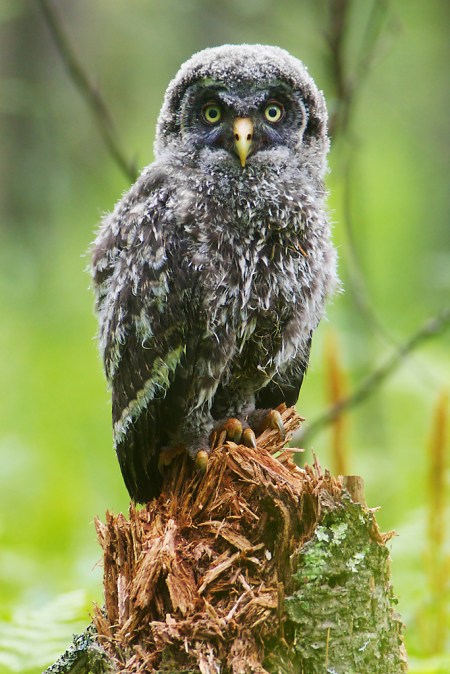
Great Gray Owl nestling Hedbom Rd Aitkin Co MN IMG_7390On June 28th I went to photograph the owlets from my blind…But I saw no action in the nest. Just as I was contemplating this, I simultaneously heard my cell phone ring as well as a screech from ground level. I assumed the screech was one of the owlets who’d left the nest. It was Kim on the phone and he was in the bog and had seen the young on the ground. As he was talking I found one of the owlets ‘teed up’ on a stump… “Found one! Gotta go.” I set up my tripod and folding chair, then draped camo netting over myself and started shooting. The owlet stared at me for 20 minutes without taking its eyes off me, though its posture relaxed over this time. Then when he/she was comfortable that I was not a predator, the owlet started to look around, and even stretch.

Great Gray Owlet stretching_0002STREEEEETCH! FRAME EXTRACTED FROM VIDEO CLIP. The young Great Grays often stretched like this…Working their flight muscles I imagine. Fortunately he was facing me head on and gave me this unique perspective. [Note that when you extract a frame from a HD video clip you only get a 1920x1080pixel image to work with…and it’s shot at 1/60 second…and its basically a jpeg. Very limited use, but fine for the web].

Great Gray Owl nestling Hedbom Rd Aitkin Co MN IMG_7389Though the owlets can’t fly at this age, they sure can get around! They will walk across the bog then climb leaning trees and stumps by using their talons for grip and using their beak to grab branches like a parrot, pulling themselves up, wings held over their back for balance.

Great Gray Owl nestling Hedbom Rd Aitkin Co MN IMG_7390 - Version 2 (1)The ticket to not alarming wild critters is to move slowly, stay low, avoid eye contact, and talk to them in a low soft voice (don’t whisper!). And stay in plain sight so you are not mistaken for a sneaky predator. I got very close to this owlet…Close enough to use my 10-20mm lens with full flash. I love the low angle and wide perspective which really puts the owl in its habitat.

Great Gray Owl nestling Hedbom Rd Aitkin Co MN IMG_7343

Great Gray Owl nestling Hedbom Rd Aitkin Co MN IMG_7302Eye-level shot with Canon 400mm f5.6. I WISH I’d put my big flash and Better Beamer on! The images looked okay on the LCD but there is a weird greenish cast from the light filtering down through the canopy. Live and learn!

Great Gray Owl nestling Hedbom Rd Aitkin Co MN IMG_7410The sibling to the owlet on the stump, is this fuzzball. I found him/her on a comfy cozy patch of super-soft Sphagnum moss. I laid on my belly, crawled towards her (got soaking wet!) and inched to within a foot of her/him. He/she began bill clacking, an alarm signal, so I snapped a few photos (full flash) and backed off.

I wish this little family well and hope they find many fat voles!

[All photos and video taken with Canon 7D and Canon 400mm f5.6 lens or Sigma 10-20mm lens, Canon 580EX flash, Cabela’s Lightning Set pop-up blind, Manfrotto tripod]