Archive for June, 2013

Last Day of my Big Half Year for the Bog! Best Bird Photos

Well, today, June 30th is the last day for our FUNDRAISER FOR FRIENDS OF SAX-ZIM BOG. It is an event we called THE BIG HALF YEAR FOR THE BOG. A “Big Year” to birders, is a challenge to see as many species of birds in a calendar year. Maybe some of you saw the highly entertaining (at least to birders) movie by the same name—The Big Year—starring Steve Martin, Jack Black and Owen Wilson. Our take was a bit different…For starters it was only a half year…and birders could set their own parameters. Each birder created their own web page to promote their effort. People can pledge lump sums or per species. All dollars donated go to the non-profit I founded, Friends of Sax-Zim Bog, whose mission is to PRESERVE, PROMOTE AND PROTECT THE SAX-ZIM BOG IMPORTANT BIRD AREA. We have already raised over $5,000 and we’ll be accepting pledges through the month of July.

CLICK HERE TO GO TO MY BIG HALF YEAR PAGE FOR PLEDGES & DONATIONS

I chose to see how many birds I could photograph in Minnesota in six months (I did annex part of western Wisconsin but don’t tell!). When planning my Big Half Year, I imagined that between family and work I could realistically digitally capture about 100 species of birds. And I wanted to really work on getting very good and creative photos, not just snapshots. Well, I nearly doubled my goal, and as of tonight June 29th, I’m at 198 species! Ninety-five percent of the images were taken within a 50 mile radius of home with the other five percent taken on a trip to Minnesota’s western prairies in May. The best part is that I feel my photos of 104 species are better or equal to any images I’ve taken of those species ever before…And I’ve added 24 new species to my collection. You can see many more of my Big Half Year photos here. Here are a few of my favorites.

Spruce Grouse male Hwy 1 milepost 302.9 Ely MN IMG_3902SPRUCE GROUSE male near Ely, Minnesota in mid winter. They live on spruce and jack pine needles in the winter but need sharp quartz rocks in their crop to help grind the needles up, so you can often find them picking grit on the roads at dawn.

Common Redpoll Admiral Road Sax-Zim Bog MN IMG_0076238 (1)I laid flat on my stomach on a snow-covered road to get this unique portrait of a COMMON REDPOLL in Sax-Zim Bog.

Wild Turkey Skogstjarna Carlton Co MN IMG_6733Believe it or not, this WILD TURKEY was displaying just outside our living room window! Photo taken through double paned glass.

Yellow-rumped Warbler Skogstjarna Carlton Co MN IMG_7224This image of a YELLOW-RUMPED WARBLER typifies the “spring” we had. Taken in LATE APRIL during a spring snowstorm, this insect-eater resorted to feeding at our suet feeder.

Turkey Vulture snow Fond du Lac Duluth MN IMG_7606Another late-spring image of a bird we rarely see in the snow…a TURKEY VULTURE.

Killdeer CR201 Sax-Zim Bog MN IMG_8053 copyBehavior shots are always interesting. These KILLDEER are not training for their circus act, but getting ready to mate up in Sax-Zim.

Horned Grebe Park Pt Duluth MN IMG_9081I love these birds! And have rarely gotten close to them. But the ice-clogged bay side of Duluth’s Park Point kept the HORNED GREBES close to shore.

American White Pelican St. Louis River Fond du Lac Duluth MN IMG_9999A AMERICAN WHITE PELICAN flock occasionally shows up in late May on the St. Louis River at Fond du Lac, Duluth. They spend a few weeks here loafing, fishing, preening, sleeping, before moving on.
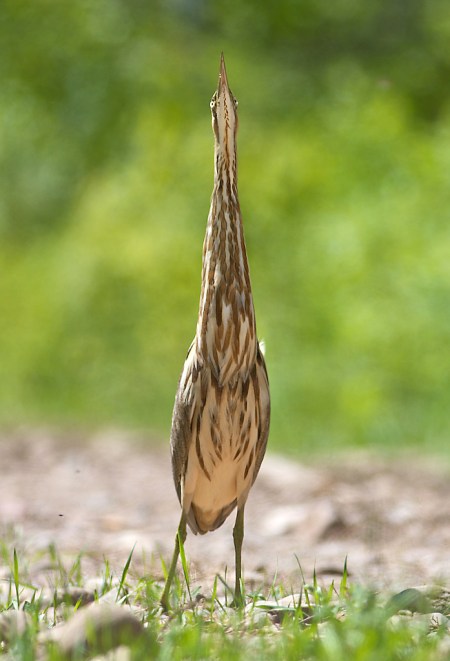
American Bittern Ditchbanks Fond du Lac S.F. Carlton Co MN IMG_5663“He can’t see me…No way…I am blending in with the cattails…Oh, wait, I’m out on the road!” is probably what this frog-hunting AMERICAN BITTERN is thinking. Fond du Lac State Forest, Carlton County, Minnesota.

Bohemian Waxwing crabapple Duluth Zoo Duluth MN IMG_8418This image of a BOHEMIAN WAXWING had to be taken in the wilds of the great white north, right? Wrong! It was taken at the Duluth Zoo as dozens of kids (noisy kids! …including my own) walked within mere feet of this crabapple tree as the flock gorged.

Sandhill Cranes corn field Carlton Co MN IMG_7534 (1)A grab-and-go image that I didn’t think much about until I got home and started to play around with it on the computer. I like the stark pattern and the curving line of corn stubble. SANDHILL CRANES in Carlton County Minnesota, late April.

Black-capped Chickadee landing on feeder Skogstjarna Carlton Co MN MG_0074299BLACK-CAPPED CHICKADEE coming to my feeder at dawn on a cold winter day, backlit by the rising sun and intentionally underexposed.

Trumpeter Swans 3 landing backlit Monticello MN IMG_0073476Monticello, Minnesota. 3 TRUMPETER SWANS
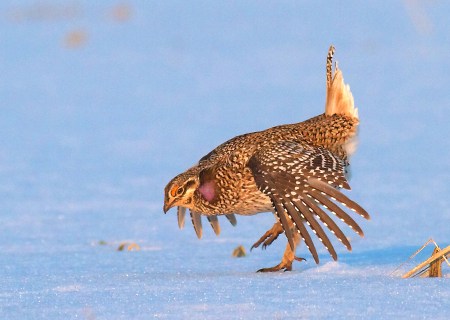
Sharp-tailed Grouse lek blind Kettle River Twp Carlton Co MN IMG_7840:I was the first person to the SHARP-TAILED GROUSE blind in Kettle River Twp, Carlton County this year…and it was late April!…and I had to trudge through a foot of snow…But I got the shot I’d always wanted…A Sharptail dancing on top of the snow in beautiful morning light.

Great Gray Owl Nichols Lake Rd closer to CR7 Sax-Zim Bog MN IMG_3891Silhouetted GREAT GRAY OWL. …the wildness of the bog lands.

Florida Part 2: Beach Life

Fort Myers Beach panorama SMALLFLORIDA. I wish I could post the full-size photo of this panorama combining 4 images in Photoshop…It is 45 inches long! …and very sharp. Taken during a brief appearance of the sun near sunset along Fort Myers Beach. Handheld with the Canon 400mm f5.6 lens.

American Oystercatcher stare Fort Myers Beach FL IMG_3995 - Version 2
American Oystercatcher preening Fort Myers Beach FL IMG_4000 - Version 2
American Oystercatcher fluffing Fort Myers Beach FL IMG_4003 - Version 2The above images were just “G&G” images for me (“grab-and-go”)…I was walking the Estero Beach Lagoon when I saw these AMERICAN OYSTERCATCHERS lolling about. I didn’t put much effort into stalking them or even setting up my tripod because the light was FLAT and the only background was blah, colorless white water. Not a very interesting background. BUT when I got home and looked at these on the computer, I knew that they were my best photos of the trip. I really like the monochromatic water background…It is a nice contrast to the brown-black and orange of the oystercatcher. By the way, yes, oystercatchers do “catch” and eat oysters! (and many other bivalves including mussels and clams)

Frigatebirds 1 composite SMALLWhat a great name!…MAGNIFICENT FRIGATEBIRD. For me the name conjures up visions of the Caribbean and the tall ships that plied these waters centuries ago. An early naturalist likely noted that the birds often came to rest on the masts of these vessels far from any land and named them “frigate birds.” These are HUGE seabirds that effortlessly float in the sky, gliding on stiff Caribbean winds, wings that span nearly EIGHT FEET(!) firmly set. They can glide like this for HOURS, never once flapping their wings. You’ve probably seen them in some nature program before…They are the birds with the red air sacs on their throat that they inflate like a balloon during breeding and courtship. But on this trip I only managed a few flight silhouettes, distinctive as they are, under gray sky conditions. But I decided to get creative and combine 5 images of the same bird into one, making my own flock of five flying frigatebirds (say that 3-times fast!). A dramatic increase in contrast helped the final image pop.

Great Egret breeding face Fort Myers Beach FL IMG_3838In the North Woods of Minnesota, we rarely get to see a Great Egret (found south in the state) and NEVER get to see them with their breeding plumage including their green facial skin. Snuck up on this guy at Estero Beach Lagoon.

Sandwich Tern flying Fort Myers Beach FL IMG_3538SANDWICH TERNS always remind me of my birding friends Parker Backstrom and Don Kienholz. Back in the mid 80s they were birding the Duluth Port Terminal on a gray, rainy, foggy May day when they spotted a strange tern with a yellow-tipped bill. It was a very-far-from-home Sandwich Tern, and a first state record for Minnesota! Dirt common in Florida as they hunt (fish) the ocean shorelines for small fish, plunging beak-first into the water.

Least Tern flying Fort Myers Beach FL IMG_3581LEAST TERN is the smallest and cutest tern in North America. I completely associate it with the Gulf Coast but amazingly, they also nest on braided, sandbar stretches of the Upper Missouri River in South Dakota (only an hour SW of the MN border), North Dakota and Montana.

Snowy Egret high key Fort Myers Beach FL IMG_3824
Snowy Egret stalking beach Fort Myers Beach FL IMG_3601SNOWY EGRET stalks critters along a busy Fort Myers beach. I didn’t think much of either of these photos UNTIL I made it a “HIGH-KEY” image, overexposing, and even blowing out completely the whites. I like the monochromatic effect and the contrasting black bill, legs and yellow feet.

Brown Pelican Fort Myers Beach FL IMG_3636Who doesn’t love pelicans? And BROWN PELICANS are the native pelican in Florida. This adult was lazily flying along the beach, but would then suddenly plunge head-first into the surf and more often than not, come up with a fish in its pouch.

Common Ground-Dove Fort Myers Beach FL IMG_3807COMMON GROUND-DOVES, like many of North America’s doves and pigeons, are taken for granted. But when you really study them, many have quite beautiful plumages, some with delicate scaling and subtle iridescence. This dove is native to the southern fringe of the U.S. from South Carolina to Florida to Texas, Arizona and S. California. When it flies, it reveals its stunning rusty red underwings.

Cicindela hamata lacerata Tiger Beetle Estero Beach Lagoon Fort Myers Beach FL IMG_3863
Cicindela hamata lacerata Tiger Beetle Estero Beach Lagoon Fort Myers Beach FL IMG_3866A lifer TIGER BEETLE! This beach tiger was a new one for me—Cicindela hamata lacerata. I love tiger beetles! Fast and furious, they pursue insect victims, pouncing on them in lightning fast attacks. And it really helps to be colored like the sand you hunt on.

Wilson's Plover Fort Myers Beach FLFunny story…WILSON’S PLOVER is a sand-colored shorebird restricted to the South Atlantic and Gulf Coast states, Virginia to Florida to Texas, BUT I’d just seen one the week before on Minnesota’s own version of an ocean beach—Duluth’s Park Point on Lake Superior. My friend Karl Bardon had found this lost wanderer, only Minnesota’s THIRD state record. Interestingly, I myself had found Wisconsin’s FIRST STATE RECORD of this species back in 2004(?) and just a few miles from here on Wisconsin Point. Anyway, good to see a Wilson’s in its native habitat for a change!

[All images taken with Canon 7D and Canon 400mm f5.6 lens handheld]

Florida Part 1: Mangrove & Key Wildlife

“Sunshine State”??…not when we were there! During the first week in June, Bridget and I took the kids to the Fort Myers Beach/Estero Beach area for a mini-family reunion for my mother-in-law’s 70th birthday. Though we only saw the sun for a grand total of 15 minutes in our six days and survived a blow from Tropical Storm Andrea (60 mph winds, torrential rain…Whitecaps in the pool!), WE ALL HAD A BLAST and I did manage to get out and shoot a bit. I visited the Estero Beach Lagoon behind the Holiday Inn several times, and Bridget and I did some hiking at Lovers Key State Park, exploring the Red Mangrove thickets and wooded hammocks.
Cuban Brown Anolis sagrei Anole Lovers Key State Park Ft. Myers Beach, FL IMG_4204Though the CUBAN BROWN ANOLE (Anolis sagrei) is a fascinating creature, it is an alien here, introduced to the U.S. in the 1970s, and is sadly crowding out the native Green Anole (and will eat them too!). This male is showing his orange-red dewlap…a common feature of lizards and anoles which is used for several reasons…1) to make itself look bigger and to warn off predators, and 2) to impress the ladies during mating season.

Mangrove Tree Crab Aratus pisonii Lovers Key State Park Ft. Myers Beach, FL IMG_4189MANGROVE TREE CRABS (Aratus pisonii) are gorgeous residents of mangroves in south Florida…This species was a lifer for me, and we saw MANY at Lovers Key State Park just south of Fort Myers Beach. Native to Florida and south to northern Brazil (on the Atlantic) and to Peru on the Pacific side. They migrate vertically in the mangrove trees, remaining higher up during high tide and then coming down to beach level at low tide. This was one of the bigger ones at 2-inches across.

Zebra Longwing Heliconius charitonius Lovers Key State Park Ft. Myers Beach, FL IMG_4210An old friend, The ZEBRA LONGWING (Heliconius charitonius) is a fairly common butterfly of south Florida, and I’ve seen them on every trip. Don’t you love it when large stunning critters are actually common! This one was nectaring at a butterfly garden in Lovers Key State Park.

Snowy Egret Lovers Key State Park Ft. Myers Beach FL IMG_4183SNOWY EGRETS are very common birds in south Florida, and can even be seen foraging in the surf line on busy beaches. This bird is still sporting its feathery finest with delicate plumes blowing in the ocean breeze. Lovers Key State Park.

Mangrove Periwinkle Littorina angulifera Estero Beach Lagoon Ft. Myers Beach FL IMG_4430Sea shells are not the only shells along the beach. Terrestrial snails also have beautiful shells. This is the MANGROVE PERIWINKLE (Littoria angulifera) found at the Estero Beach Lagoon in, what else, a Mangrove!

Mangrove Periwinkles Littorina angulifera Estero Beach Lagoon Ft. Myers Beach FL IMG_4401 A group of MANGROVE PERIWINKLES (Littoria angulifera). Note the variation in shell patterns.

White Ibis Estero Beach Lagoon Ft. Myers Beach FL IMG_4322WHITE IBIS at Estero Beach Lagoon. Check out those blue eyes! Mainly found in the Gulf Coast states in the U.S.

White Ibis Estero Beach Lagoon Ft. Myers Beach FL IMG_4318WHITE IBIS at Estero Beach Lagoon. They used that wicked curved bill to pluck crayfish and other crustaceans from water and mud and grass. Will also occasionally eat insects and small fish.

flower Lovers Key State Park Ft. Myers Beach FL IMG_4252Bridget pointed out this unfurling wildflower in Lovers Key.

Basilica Orbweaver Mecynogea lemniscota Lovers Key State Park Ft. Myers Beach, FL IMG_4234The BASILICA ORBWEAVER (Mecynogea lemniscota) builds a very complex web. In fact, its common name comes from the basilica-like dome it creates by pulling up its horizontal orb web with guy threads (visible in the photo). Native to wetland woods in the SE U.S.

Sea Grape Coccoloba uvifera Lovers Key State Park Ft. Myers Beach, FL IMG_4227SEA GRAPE (Coccoloba uvifera) is a distinctive and common plant of beach dunes and wetland woods. Because of its high tolerance to salt, it is an important dune stabilizer of Florida beaches. Grape-like clusters of fruit hang in bunches and are edible once they ripen red. You can even make jams and jellies out of the fruit.

Lined Tree Snail Drymaeus multilineatus Lovers Key State Park Ft. Myers Beach FL IMG_4205LINED TREE SNAIL (Drymaeus multilineatus) is another attractive mollusk of the wetland forests.

[All photos taken with Canon 7D, Canon 400mm f5.6 lens or Tamron 100mm f2 macro, handheld.]

NEXT POST: FLORIDA PART 2—BEACH LIFE

Prairie Spring—Western Minnesota’s Felton Prairie

It’s always good to get back out to the prairie…and western Minnesota’s Felton Prairie is always a nice escape from the North Woods. Just a few of my favorites from this mid May trip to Clay and Norman Counties. Enjoy! (pssst…We’re off to Florida…I’ll post photos when I get back)
Marbled Godwit Felton Prairie Clay Co MN IMG_1484Marbled Godwit…a very large and raucous shorebird that makes its home on medium-grass prairies.

Brewer's Blackbird Felton Prairie Clay Co MN IMG_1642 (1)Brewer’s Blackbird

Brewer's Blackbird Felton Prairie Clay Co MN IMG_1243Brewer’s Blackbird

Upland Sandpiper Felton Prairie Clay Co MN IMG_1343Upland Sandpiper

White-tailed Deer near Felton Prairie Clay Co MN IMG_1394

Northern Shoverler male near Felton Prairie Clay Co MN IMG_1408Northern Shoveler
Wind Turbines Felton Prairie Clay Co MN IMG_1381

Marbled Godwit Felton Prairie Clay Co MN IMG_1477Marbled Godwit

Marbled Godwit Felton Prairie Clay Co MN IMG_1468Marbled Godwit

Western Meadowlark Felton Prairie Clay Co MN IMG_1539Western Meadowlark. Great to hear their melodious song since we get the less melodious Eastern Meadowlark near Wrenshall.

Northern Harrier Felton Prairie Clay Co MN IMG_1585Northern Harrier

Yellow Warbler Felton Prairie Clay Co MN IMG_1597Yellow Warbler

Swamp Sparrow Felton Prairie Clay Co MN IMG_1734Swamp Sparrow

Lark Sparrow Agassiz Dunes SNA Norman Co. MN IMG_1931Lark Sparrow a bit further north, near Agassiz Dunes SNA in Norman County

Sedge Wren Felton Prairie Clay Co MN IMG_1716Sedge Wren

Sedge Wren Felton Prairie Clay Co IMG_1694Sedge Wren

Bank Swallow colony Agassiz Dunes SNA Norman Co. MN IMG_1878Bank Swallow Colony in an old gravel pit…This colony has made this cut its home for many years.