Archive for July, 2012

Floating Blind Hide & Seek: Rail-a-palooza!
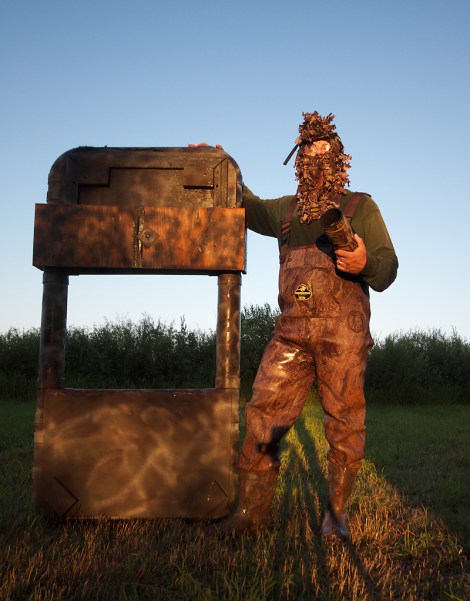
Sparky all dressed up with SOMEWHERE to go!
Kimmes-Tobin Wetlands, Douglas County, Wisconsin

It was a gorgeous afternoon in Duluth yesterday…Absolutely clear, sunny, and about 70 degrees. I knew I had to get out of the office and into my floating blind ASAP (“floating hide” according to the Brits). So Bridget and I picked up the kids at daycare and grabbed a take-out Hugo’s Pizza on the way home (1/2 green olive and black olive, and 1/2 sausage and mushroom if you must know…Best pizza in Duluth…Thin and greasy!) This expedited the usually lengthy dinner circus so I could get out to the marsh before sunset.

Fortunately for me, we live only five miles from one of the best and most expansive cattail marshes for many miles around. Kimmes-Tobin Wetlands is a string of manmade wetland mitigation ponds created in 1993 on 470 acres by the Wisconsin DNR to replace wetlands lost through the construction of US53, WI35 and WI13. I stepped into my new neoprene waders that Bridget got me for father’s day…Luxurious compared to the last few pairs of leaky hand-me downs. Pulled on my camo mask and eased the PVC floating blind into the water. There’s a few things you seem to conveniently forget between your trips…
1. Swamp gas really stinks!
2. Leeches thrive in these ponds
3. Muck and pond weeds are not easy to crawl through
4. Cold water ALWAYS spills over the top of your waders just as you’re leaning over to take an award-winning shot.
5. Every thing your leg bumps into under water MUST be a feisty Snapping Turtle
6. …and Wood Ducks are notoriously spooky!

It was nice just being out…even though it was under the dome of visibility-limiting camo netting. Not a breath of wind…Not a cloud on the horizon. A pair of striped juvenile Pied-billed Grebes gave me the slip…Too bad, they are interesting looking birds, Then in quick succession a female Mallard and two Wood Ducks wanted no part of this floating green and brown blob with one giant eye. But then I spotted a pair of loafing juvenile Wood Ducks. They seemed pretty relaxed on their log, so I slowly worked my way towards them.

juvenile Wood Ducks [Canon 7D with Canon 400mm f5.6 on ball head with Wimberly Sidekick, f5.6 at 1/1000 ISO 200]

Sora [Canon 7D with Canon 400mm f5.6 on ball head with Wimberly Sidekick, f5.6 at 1/1000 ISO 200]

Time to head home…So I plucked a few leeches off me, jettisoned about 100 pounds of pond weeds that were clinging to my legs, and waded to the narrow canal leading to my take out point…Then a movement caught my eye…It was a juvenile Sora coming out of its safe zone in the cattails to feed on a tiny mudflat. The light was golden and hit the Sora like a spotlight. I underexposed by a stop and a half so to keep the background black and keep the bird from blowing out. I was less than 25 feet away!

Virginia Rail juvenile stretching [Canon 7D with Canon 400mm f5.6 on ball head with Wimberly Sidekick, f5.6 at 1/250 ISO 1000]

A second rail was coming out to the flats…I assumed it was a second Sora, but turned out to be a Virginia Rail…Even more unusual than the Sora. It is a bird restricted to cattail marshes and we have few this far north. This was a juvenile also…Not as colorful as the adult but still a striking bird. By now the spotlight of sun was gone and it only backlit its hind end. But this rail put on a show. Check out the brief video clip (excuse the slight motion from trying to keep the blind stable while shooting). This is the real beauty of the floating blind…You could NEVER get this close to any rail, let alone watch it feeding, bathing and stretching. Oh, and did I mention that a Muskrat swam within five feet of me?

Virginia Rail juvenile [Canon 7D with Canon 400mm f5.6 on ball head with Wimberly Sidekick, f5.6 at 1/200 ISO 640]

frog [Canon 7D with Canon 400mm f5.6 on ball head with Wimberly Sidekick, f5.6 at 1/1000 ISO 200]

p.s. I have instructions on how to make a floating blind on my DVD (and much more video): Get Close & Get the Shot: Wildlife Photography Tips & Tricks. Available for purchase (DVD or download) at www.getclosevideo.com

13 Tips for Stunning Butterfly Photos

Getting a beautiful, artistic photo of a butterfly is more of a challenge than you’d think. After all, they are attractive insects that regularly perch on attractive flowers. How hard could it be? But the challenges are many…How do you get close? What lens do you choose? Why is the background so cluttered? Here are 13 tips that will improve your butterfly images 100 percent.

1. GET EYE LEVEL

Silver-bordered Fritillary (Boloria selene) on Daisy Fleabane, MN

This is probably the #1 tip to getting better butterfly photos (combined with Tip #2). I’ve said it before and I’ll say it again, eye-level photos bring greater intimacy to the photo and a stronger connection to the critter by the viewer. So you’ll be doing a lot of crouching, kneeling, stooping and crawling through meadows, but it will be worth it.

2. USE A TELEPHOTO LENS

Marine Blue (Leptotes marina) Lower Rio Grande Valley, Texas

It is VERY DIFFICULT to get great, or even good butterfly images with a wide angle or normal (50mm) lens. The short focal length does not give you enough working distance…i.e. you can’t get close enough to skittish butterflies (almost all fall into this category!) to make them large enough in the frame for a pleasing image.) And if you could, the wide and regular lenses allow too much depth of field so that you would have a cluttered background of in-focus leaves and stems. I shoot almost ALL of my butterfly images with a 200mm lens mounted on a 1.6x crop-sesor DSLR so it effectively becomes a 320mm lens! This allows me to shoot from a distance that does not spook the butterfly and gives me a shallower depth of field so background vegetation blurs nicely.

3. SUPER MACRO

Tiger Swallowtail (Papilio canadensis) Sax-Zim Bog, MN

The crazy and wonderful patterns on all butterfly wings are the result of colored scales. In this cropped close up of a road-kill Tiger Swallowtail’s hind wings you can see the individual scales. Maybe you remember a poster that showed the entire alphabet, each letter a macro image from a butterflies wing. Fresh road-kills are great for this purpose as few living butterflies would allow this close approach. Now you can use your 60mm or 100mm macro to zoom in on the detail. Great for the “Wow Factor.”

4. BACKLIT BEAUTY

Silver-bordered Fritillary (Boloria selene) Minnesota

This is a fun technique to try later in the afternoon when you have butterflies perching atop wildflowers with dark backgrounds. Underexpose by at least 1 stop…maybe 2 stops…to get this effect. The wings just seem to glow. Remember to turn off your flash too!

5. WATCH YOUR BACKGROUND

European Skipper (Thymelicus lineola) Carlton Co, MN

The nicely blurred, smooth green background (called “buttery bokeh” in photographer jargon) in the image above is the holy grail of butterfly photography. But it is difficult to achieve. The trick is having the background vegetation far enough away so it blurs at the f-stop you are shooting at, yet keeping all or most of the butterfly sharp at the resulting depth of field. To get this effect, I am often shooting at f5.6 to f8…depending on if the butterfly’s wings are held flat or together over its back (f5.6) or slightly spread (f8 to get more depth of field).

6. WAIT FOR THE FLOWER

Sheep Skipper (Atrytonopsis edwardsii) Big Bend National Park, Texas.

Sometimes a drab butterfly can play second fiddle to the flower it is feeding on. Such was the case with this brown-gray Skipper nectaring on this stunning cactus flower. This principal can apply to all butterfly photography…Park your butt at a magnificent specimen of a flower and wait…On hot sunny midsummer days you shouldn’t have to wait too long.

7. GET HORIZONTAL (AND DIRTY!)

Baltimore Checkerspot (Euphydryas phaeton) Cranberry Rd Sax-Zim Bog MN

Many species of butterflies perch on the ground (especially dirt roads and trails) where they take up water and minerals from the soil or animal dung. But a photo from the standing position may help you identify the beast but not be a very pleasing image. So I usually find a subject that seems to be preoccupied with feeding, lay down on the ground a safe distance away and slowly work my way closer. It is rather painful on elbows and knees and necks but does not alarm the bug as much as approaching on foot. When I get within range, I switch to LIVE VIEW so I can view the butterfly on the back of the camera. I then just extend my arms and watch the Live View until I have my perfect framing and subject size. Of course, the success ratio for all butterfly photography is VERY LOW so don’t get discouraged; Try, try again.

8. FILL FLASH

Monarch (Danaus plexippus) on Liatris, Carlton Co, MN

Maybe 50% of the time I’ll use fill-flash in my butterfly photography. It helps define wing patterns on sunny days, illuminates shadowed underwings and faces, and can freeze motion. I either use the pop-up flash or an external flash and always set it to -1 1/3 e.v. BUT if the sun is at my back and not high overhead, I probably won’t use it. Sometimes it becomes difficult to use it on sunny days too because even at low ISOs you have to have a small aperture (f16) to shoot at the flash sync speed (1/250 for me)…and then the background is too much in focus.

9. DON’T FORGET THE UNDERSIDES

Red Admiral (Vanessa atalanta) Carlton Co, MN

The undersides of many species wings are as spectacular, or in some cases, even more stunning than the pattern on the top side of their wings. This is true for many fritillaries whose top sides are all very similar, a patchwork of orange and black markings, but underneath they have distinctive and colorful spots and patches.

10. …AND DON’T FORGET THE CATERPILLAR!

Monarch caterpillar (Danaus plexippus) on Milkweed, Carlton Co, MN

Though most spectacular caterpillars that you come across are actually the larva of moths, there are some stunning butterfly caterpillars. The Monarch’s caterpillar comes to mind first, but the larva of the Baltimore Checkerspot and most swallowtails also make great subjects. And don’t forget the Harvester caterpillar…It is the only carnivorous butterfly caterpillar, feeding on woolly alder aphids.

11. BUTTERFLY IN HABITAT

Common Ringlet (Coenonympha tullia) Western Minnesota

You don’t always have to get frame-filling images. Sometimes it is good to back off and include more habitat. This Common Ringlet is a butterfly of prairies, marsh edges, meadows and other open country so in addition to the close-up I also got a wider shot showing the grassland habitat.

12. FLIGHT

Regal Fritillary (Speyeria idalia) Nachusa Grasslands in northern Illinois


Pipevine Swallowtail (Battus philenor) and Texas Bluebonnets, near Alice, Texas.

Here’s a challenge for you; Try to shoot a butterfly on the wing! Autofocus won’t work—the butterfly is too small in the frame—so you need to manually focus. Talk about low-percentage shooting! Though this swallowtail is not sharply in focus, I still think it works as a unique flight-habitat image. p.s. I went back to this same ranch the following April and due to drought there was not a single flower in this pasture!

13. KNOW WHERE TO GO…BUTTERFLY MAGNETS

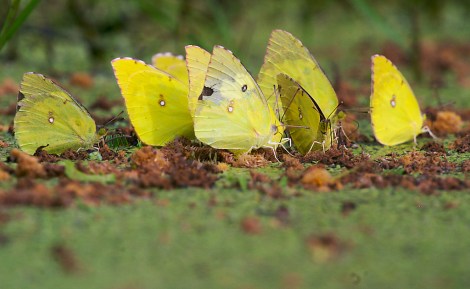
Sulphurs “puddling” in South Texas

Knowing when and where to go are about as important as all other tips. First, get a good regional butterfly guide and study it. It should give you an idea of when the butterflies on the wing (“flight phenology”) and the habitat to look for them. Behavior can also lead you to subjects; “Puddling” as in photo above is when several butterflies concentrate at wet soil or mud to take up nutrients. On top of hills or slight rises with openings you may find mixed groups of butterflies “hilltopping,” a common butterfly behavior. Animal dung/scat also attracts butterflies who take up nutrients from the dried piles…But this doesn’t make for very attractive photos! Bottom line…Get to know the biology of your subjects and your chances of success improve greatly.

Okay, a shameless plug for a field guide to butterflies of the North Woods (which includes species of Minnesota, Wisconsin, and Michigan) published by my company (www.kollathstensaas.com) and written by my friend and neighbor, Larry Weber. Includes all 125 species found in the North Woods and phenograms, habitat, identification and biology for each. You can Buy it at Amazon.