Dream Come True: Witness to a Great Gray Owl nest
 Two Great Gray Owlets await mommy or daddy from their lofty nest in a large Tamarack.
I had the great fortune of having a good friend who was willing to share the location of a Great Gray Owl nest he had found recently. Kim Risen is a professional bird guide based out of Tamarack, Minnesota, who leads birding trips across the globe, from South Africa to South America to Costa Rica to Mexico and even in his ‘backyard’ of northern Minnesota. Kim found this nest on a June trip with a client. He’d seen young in this general vicinity several times over several different years. He graciously shared the site with me.
I first visited the Black Spruce/Tamarack bog with Kim and his wife Cindy on June 18th and made several more visits, the last on June 28th. Two owlets were in the nest until at least June 24th, then must have “flew the coup” around June 27th or 28th when we found them on the ground.
VIDEO SHOWING BEHAVIOR & COMMENTARY ON FAVORITE PHOTOS (7 MINUTES)
You can see more of my wildlife videos HERE
 Note mom in the bottom left corner of the image…She was never very far away. The young were generally silent…until they saw an adult when they gave a loud screech (can hear it late in the video). But the female often gave a rising “Whoop!” call. Robert Nero, one of the world’s foremost authorities on Great Gray Owls, says this call “is often given by the female on the nest as a means of communicating with the male.” Robert Taylor, author of The Great Gray Owl: On Silent Wings calls this is “food request call” and it is given more frequently during years of low vole supplies. It likely helps the male find the female too as he delivers the food to her so she can feed the owlets. May this also be the female’s form of communication with the owlets?…”You’re okay…I’m right here.”
 On June 28th I went to photograph the owlets from my blind…But I saw no action in the nest. Just as I was contemplating this, I simultaneously heard my cell phone ring as well as a screech from ground level. I assumed the screech was one of the owlets who’d left the nest. It was Kim on the phone and he was in the bog and had seen the young on the ground. As he was talking I found one of the owlets ‘teed up’ on a stump… “Found one! Gotta go.” I set up my tripod and folding chair, then draped camo netting over myself and started shooting. The owlet stared at me for 20 minutes without taking its eyes off me, though its posture relaxed over this time. Then when he/she was comfortable that I was not a predator, the owlet started to look around, and even stretch.
 STREEEEETCH! FRAME EXTRACTED FROM VIDEO CLIP. The young Great Grays often stretched like this…Working their flight muscles I imagine. Fortunately he was facing me head on and gave me this unique perspective. [Note that when you extract a frame from a HD video clip you only get a 1920x1080pixel image to work with…and it’s shot at 1/60 second…and its basically a jpeg. Very limited use, but fine for the web].
 Though the owlets can’t fly at this age, they sure can get around! They will walk across the bog then climb leaning trees and stumps by using their talons for grip and using their beak to grab branches like a parrot, pulling themselves up, wings held over their back for balance.
 The ticket to not alarming wild critters is to move slowly, stay low, avoid eye contact, and talk to them in a low soft voice (don’t whisper!). And stay in plain sight so you are not mistaken for a sneaky predator. I got very close to this owlet…Close enough to use my 10-20mm lens with full flash. I love the low angle and wide perspective which really puts the owl in its habitat.
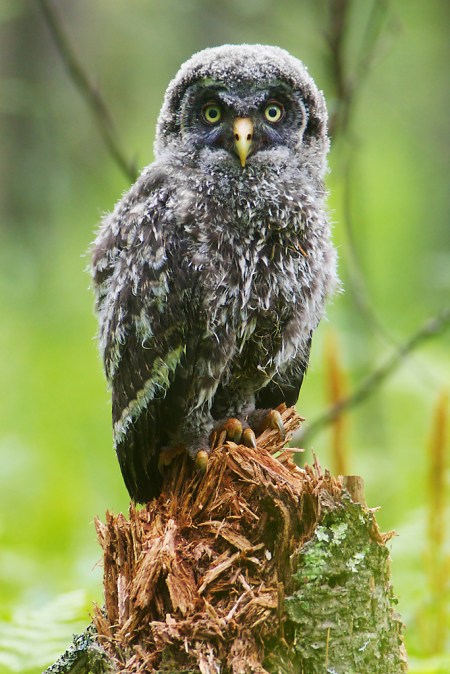
 Eye-level shot with Canon 400mm f5.6. I WISH I’d put my big flash and Better Beamer on! The images looked okay on the LCD but there is a weird greenish cast from the light filtering down through the canopy. Live and learn!
 The sibling to the owlet on the stump, is this fuzzball. I found him/her on a comfy cozy patch of super-soft Sphagnum moss. I laid on my belly, crawled towards her (got soaking wet!) and inched to within a foot of her/him. He/she began bill clacking, an alarm signal, so I snapped a few photos (full flash) and backed off.
I wish this little family well and hope they find many fat voles!
[All photos and video taken with Canon 7D and Canon 400mm f5.6 lens or Sigma 10-20mm lens, Canon 580EX flash, Cabela’s Lightning Set pop-up blind, Manfrotto tripod]
 July 31, 2013
 Sparky Stensaas
 17 Comments




 thesparkygroup@gmail.com